
A reply to Jonquilyn Hill's "What we lose when we stop writing by hand."
The keyboard is the reason you're reading me at all. I have dysgraphia; when writing by hand, the distance between what I think and what lands on the page is a chasm. At a keyboard it's nothing. I built a career in the gap that the keyboard closed, and I'm not unusual — I'm one of the many who took up software engineering in part because it was by definition typewritten. So when Vox runs a piece on what we lose by writing less by hand, and frames handwriting as a skill we must protect "for human society going forward," I will answer that framing directly:
Typing, not handwriting, is the foundational literacy of the future — and it is also the more universal and more humane of the two.
That's a claim you can disagree with. I will defend it, starting with the other side's best case.
What handwriting actually claims
The pro-handwriting argument is not nonsense. There's real evidence that forming letters by hand in the earliest grades helps kids learn to read: the motor act of producing a letter reinforces recognizing it, and researchers who study this, like Iowa's Shawn Datchuk, point to a genuine link between handwriting and early literacy. Fine-motor development is good for small hands. And cursive is a genuine cultural inheritance: a grandmother's letter, the Constitution of the United States, a signature. Losing the ability to read it does sever a thread to the past.
I'll grant all of it. Early letter formation belongs in kindergarten. Handwriting is worth real instructional time and real care. We absolutely should be investing more than 10 minutes a week of classroom time in handwriting in the early grades.
But they assigned the future to the wrong skill
The Vox framing makes a move it never examines: it takes handwriting's benefits — which are developmental and retrospective — and quietly relabels them as foundational for what comes next. Those are not the same claim, and the evidence only supports the first.
Handwriting helps a six-year-old learn that this shape is a b. It connects us to documents already written. Both are real. Neither tells you what literacy a twelve-year-old needs to participate in the world she's actually going to live in. For that, look at where writing does its work now: email, code, documents, applications, messages, everything published to the open web. Essentially all of it is typed. The standards already concede this. The Common Core writing expectations ramp keyboarding stamina year over year, not because someone thought it was trendy, but because the assessments themselves went digital and, more to the point, because the adult world did. Typing doesn't connect us to the past; it admits us to the present.
And the gap closes from the other direction too: handwriting itself increasingly resolves into typed text. Write on an iPad with an Apple Pencil and Scribble turns the strokes into Unicode as you go; aim a phone camera at a handwritten note and Live Text lifts the words off the page as selectable characters. Handwriting recognition on tablets and cameras has turned the pen into one more input method, and its output lands where every keystroke already lands: a string of Unicode. That encoded text — not the ink, not any particular keyboard — is the real universal layer, the most portable way an idea can be shared, online and off. A printed book is typeset from it; a web page is served as it; a screen reader reads it aloud. Handwriting, at its most useful, has become a way of entering that representation, not an alternative to it.
And the cognitive case that handwriting boosters love actually belongs to typing too. The reason transcription matters is that when the mechanical act of getting words down is automatic, it stops stealing the working memory you need to actually compose. That's the whole finding: transcription fluency frees composition. Automatic handwriting does it; automatic typing does it at least as well, and usually faster, and it's editable. The drafting-and-revising process every school claims to teach is native to the keyboard and hostile to the pen.*
Ask a novelist
The romantic case for analog writing has a typewriter problem.
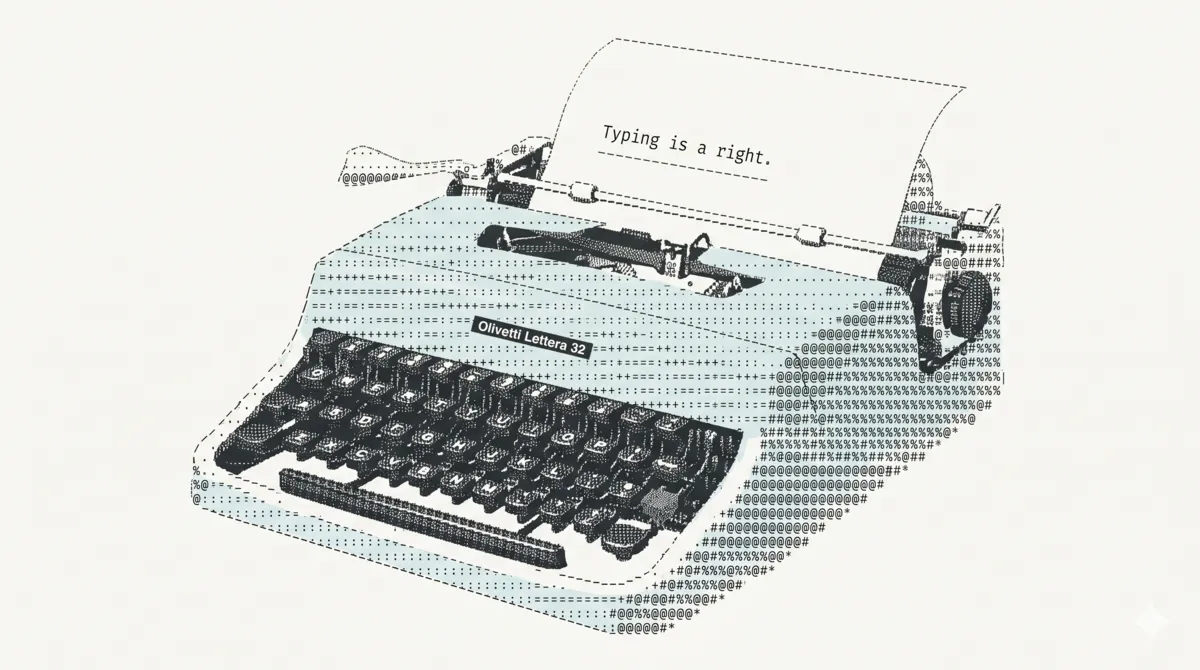
Cormac McCarthy wrote nearly everything he published — Blood Meridian, The Road, by his own estimate around five million words — on one light-blue Olivetti Lettera 32 he bought for $50 in 1963. When he finally let it go, it sold at Christie's for $254,500. Hemingway had his Royal, Maya Angelou her Adler, a long roster of writers their chosen machines. Their reasons are the exact vocabulary the handwriting camp uses for the pen: focus, ritual, the tactile clack, freedom from digital distraction, the limitation that stops you endlessly deleting and forces you to mean a sentence before you commit it.
A typewriter is a keyboard. And it delivers every virtue Vox attributes to handwriting — the embodiment, the concentration, the slowing down — with none of the motor toll the pen charges. So those virtues were never properties of the pen. They were properties of a single-purpose tool without the interruptions of ads or social media.
What focuses a writer isn't forming letters by hand; it's an instrument that does one thing only. The handwriting romantics felt the distraction of the modern machine, correctly, and blamed the wrong layer — the typing, instead of the always-on network bolted on top of it. Take the network away and the keyboard concentrates the mind as well as any fountain pen. That's why a quarter-million-dollar Olivetti exists.
The part that's personal, and the part that should be decisive
The "human society going forward" framing should have forced this question and didn't: typing includes more people.
Handwriting has a hard floor of motor ability. For me it's dysgraphia; others dyspraxia, cerebral palsy, tremor, arthritis, a missing hand. For the long tail of human variances, fluent handwriting is simply not available, and no amount of practice or cultural reverence changes that. The pen privileges one fine-motor profile and writes off everyone outside it.
Typing degrades gracefully across nearly all of those bodies. It has voice input, switch access, predictive text, one-handed layouts, eye-tracking, the whole apparatus of augmentative communication. It is far closer to universal design than handwriting will ever be. So if you are genuinely asking which literacy "human society" should carry forward — all of human society, not just the people whose hands cooperate — the answer is the one that locks the fewest people out. That's not the pen. It never was.
I'm a mild case, and the system still mishandled me. In the fourth grade my grandmother drilled me verbally on spelling lists until I could pass the Friday test, the help the school didn't offer. In high school I asked for the accommodation of a laptop for note taking and was refused, then graded on handwritten notes I couldn't read back myself. I was willing to buy a used laptop at a time when only flying business people used them. The institution insisted on the pen, then marked me down for the result.
And I got off easy. Somewhere there's a kid who will never hold a pencil and who has something to say, and whether she gets to say it in writing depends on whether we treat typing as foundational or as a fallback.
What a sane curriculum does
I teach computer science, and I watch the gap every term. High schoolers who have carried a phone since elementary school sit down at a keyboard and can't find the semicolon, the brackets, the tilde. Group chats never asked them to learn those symbols. English instruction has de-emphasized punctuation over decades, so when I introduce new syntax I end up teaching the keyboard underneath it. We assumed phones would cover typing; phones taught them to thumb-type, not to touch-type. The skill we treat as foundational got skipped, because everyone assumed it had already happened.
None of this means burning the pencils. It means putting each skill where it belongs:
- Teach letter formation early, to everyone: for reading, for the hands, for the inheritance.
- Teach typing as the foundational writing skill it actually is, deliberately, the way we once taught penmanship.
- Screen for the kids handwriting fails, and hand them the keyboard early, as a first-class tool and not a concession.
- Treat cursive as heritage, like Latin or a craft — worth exposure, not worth pretending it's job training.
Vox is mourning a beautiful thing. But you can love an inheritance without making it the entrance exam. Handwriting is something we should hand down with care. Typing is something we should guarantee as a right. The pen was never neutral about who got to write; the keyboard, for the first time, can be.
No one read Vox's case for handwriting in handwriting. They typed it, set it, and shipped it to a million screens — the whole argument, made by the side that would deny it. Because the argument for learning to type is to participate in public discourse. As Vox and now I have.
-dwk
*The famous study saying longhand notes beat laptop notes for learning failed to replicate; the science under the sermon is thin. ⏎